

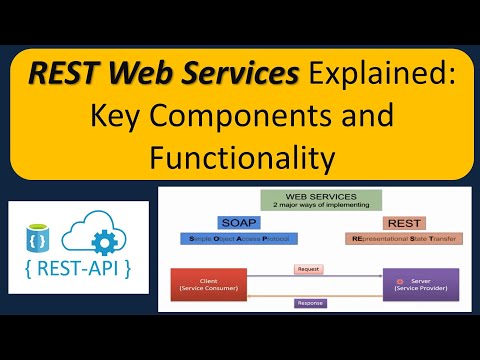
Welcome to our comprehensive web service tutorial focusing on REST (Representational State Transfer) web services. In this tutorial, we’ll explore the fundamentals of RESTful web services, including their definition, architecture, and principles.
**Key Points Covered:**
1. **Introduction to REST Web Services**: We’ll start by providing an overview of RESTful web services, explaining their significance in modern web development. Learn how RESTful architecture enables communication between distributed systems over the internet.
2. **Understanding REST Principles**: Delve into the core principles of REST, including statelessness, uniform interface, client-server architecture, and resource-based interactions. Understand how these principles shape the design and implementation of RESTful APIs.
3. **RESTful Architecture**: Explore the architecture of RESTful web services, including the components such as resources, URIs (Uniform Resource Identifiers), representations, and HTTP methods. Learn how RESTful APIs use HTTP protocols for communication.
4. **Resource Representation**: Understand the concept of resource representation in RESTful web services. Explore how resources are represented using various media types, such as JSON (JavaScript Object Notation) and XML (eXtensible Markup Language), and how clients interact with these representations.
5. **HTTP Methods in REST**: Explore the role of HTTP methods (GET, POST, PUT, DELETE, etc.) in RESTful architecture. Understand how each HTTP method corresponds to a specific CRUD (Create, Read, Update, Delete) operation on resources.
6. **Statelessness and Scalability**: Gain insights into the benefits of statelessness in RESTful web services, including improved scalability, reliability, and performance. Understand how statelessness simplifies the architecture and enables better fault tolerance.
7. **Best Practices and Implementation Guidelines**: Explore best practices and implementation guidelines for designing and developing RESTful web services effectively. Learn about resource naming conventions, error handling, versioning, and security considerations.
Whether you’re a web developer, software architect, or IT professional, understanding RESTful web services is essential for building scalable, reliable, and interoperable systems. Subscribe to our channel for more tutorials, guides, and insights on web service technologies and best practices. Like, share, and comment to join the conversation and stay updated on the latest developments in RESTful API design and implementation. Thank you for watching!
REST Web Services Explained: Key Components and Functionality | What are REST Web Services? | Web Service Tutorial
Click the below link to download the Java Source code and PPT:
https://drive.google.com/file/d/1I3u2EUWZr2dq7Xv_NQcVwgLcoEq631Za/view?usp=drive_web
Click the below Github link to download the Java Source code and PPT:
https://github.com/ramram43210/Java_Spring_2019/tree/master/JavaEE_2020/What_REST_WebServices_1
Click the below Bitbucket link to download the Java Source code and PPT:
https://bitbucket.org/ramram43210/java_spring_2019/src/master/JavaEE_2020/What_REST_WebServices_1
You can find each topic playlist here – https://www.youtube.com/user/ramram43210/playlists
#Webservice,#restfulwebservices,#restful,#REST,#restfulwebservice,#RESTAPI,#WebserviceTutorial